Guides
How to choose a robot lawn mower for your garden
Three numbers decide which robot lawn mower fits: the area of your lawn, the steepest part of the garden and how many tight spots the mower must pass. Navigation comes next. This guide explains how to read the specifications and which questions to settle before you buy.
By the Mowfriend editorial team Updated How we work
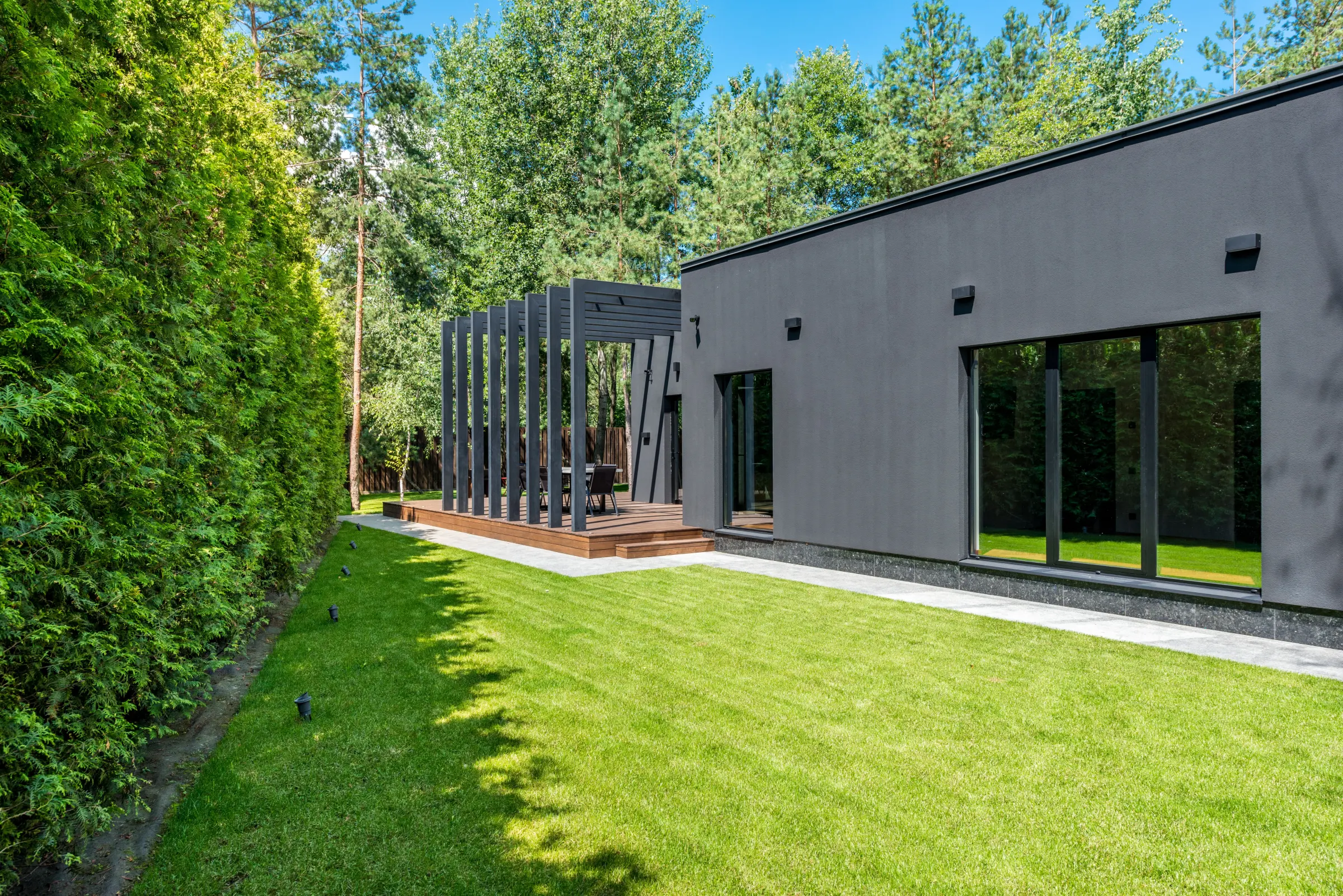
Which robot lawn mower model is best for my garden?
The best model is the one whose rated area, maximum slope and navigation match your garden, not the one with the longest feature list. Measure the lawn, find the steepest bank and look at trees or buildings that block the sky. Then compare only the mowers that clear all three with room to spare.
A simple order helps: area first, slope second, navigation third, then the app and everyday details. Starting with a model you like the look of often ends with a mower that works on paper but runs at its limit in your garden. Our overall picks are on the page for the best robot lawn mower, and every model with its specifications is in the robot lawn mower comparison.
How much lawn area should the mower be rated for?
Choose a mower rated for at least 20 to 30% more than the area you mow. Makers state the maximum area under ideal conditions: an open, flat, rectangular lawn with nothing in the way. Flower beds, trees, narrow strips and routes between two lawns all cost mowing time, so a mower sized exactly to your lawn tends to fall behind.
Measure only the grass. Take the length and width of each rectangle, multiply them and add the parts together, then subtract patios, beds and the shed. Our lawn size calculator does the sums and shows which of the models we compare are rated for your lawn.
Rough bands make the choice easier. Up to about 500 m² is a typical suburban garden, which the robot mowers for small gardens cover. Above about 1,000 m², battery time, cutting width and charging time start to matter, and the robot mowers for large gardens are built for that.
What slope can a robot mower climb?
Slope ratings are given in per cent, not degrees, and the two are easy to confuse. A 100% slope is 45 degrees; 30% is about 17 degrees and 45% about 24 degrees. Measure the steepest part of the lawn the mower has to drive over, then pick a mower whose rating sits clearly above it.
To measure, lay a straight plank of known length on the slope, hold one end level with a spirit level and measure the vertical gap to the ground. The gap divided by the length, times 100, is the slope in per cent. A one-metre plank with a 25 cm gap means 25%.
Most two-wheel-drive mowers stop at 30 to 45%. Banks above that need all-wheel or four-wheel drive. Wet grass reduces grip, so a mower working near its limit will slip more after rain. Our page on the robot mower for slopes compares the models that climb furthest.
Perimeter wire, RTK, LiDAR or camera: which navigation?
A perimeter wire is proven and independent of satellites, but it must be laid round the lawn. RTK uses satellites with a correction signal and needs open sky. LiDAR scans the garden with a laser and copes with trees and buildings. Camera-only mowers need good light and a fairly even lawn. Your garden decides which one works.
An open lawn with clear sky suits RTK, which gives centimetre-level positioning and lets you draw zones in the app. A lawn surrounded by tall trees or close to the house can block the satellite signal, which is where LiDAR earns its place. A camera-only mower installs nothing but the charging station. The full comparison is in our RTK vs LiDAR vs vision guide, and the matching shortlists are the GPS robot lawn mower page, the LiDAR robot mower page and the robot lawn mower without perimeter wire page.
If you prefer a wire, read how the perimeter wire works and what laying it involves before you decide.
How do robot mowers cope with trees, beds and narrow passages?
Trees and beds are handled as no-go zones, either with the wire or drawn in the app. Obstacles left on the lawn, such as toys or a hose, need sensors: a bump sensor reacts on contact, while cameras, LiDAR and ToF sensors try to steer round them. Narrow passages need enough width for the mower and, with RTK, enough sky.
Count the bottlenecks between parts of the lawn. A gap of under a metre between a wall and a hedge is a common trouble spot for RTK mowers, because the signal weakens next to tall objects. Makers that combine RTK with a camera say this keeps the mower on track where the satellite signal drops.
Surface roots and dips also matter. eufy says its camera models work best on a mostly flat lawn with variations under 3 cm, so a bumpy old lawn may need some levelling first.
Does a robot mower cut right up to the edge?
Not completely. The blades sit inside the body, so most robots leave a strip of a few centimetres along walls, fences and raised beds. Mowers with an edge mode or offset blade get closer, and a lawn edge laid flush with the grass, such as a paving strip, lets the mower ride over it and cut the last part.
Worx calls its feature Cut-to-Edge, eufy uses Ride-on-Edge and Dreame has an Edge Mowing Mode. The makers describe them differently, so look at whether the mower can drive with one wheel on a hard edge. Plan on a quick pass with shears or a strimmer along walls every few weeks.
Do you need Wi-Fi, 4G or an app?
All twelve models we compare are set up and scheduled through an app. Wi-Fi in the garden is usually enough, but camera-only and cloud RTK mowers rely on a steady connection to work properly. Where Wi-Fi does not reach, a 4G module or mobile data plan fills the gap, and it also helps track a stolen mower.
Check the Wi-Fi signal where the charging station will stand with your phone before buying. eufy says its camera models need a stable Wi-Fi or 4G signal in the garden. Worx says the cloud RTK service on the Vision Cloud L1800 is included with no extra subscription, but it still needs Wi-Fi or 4G to receive corrections.
What about noise, theft, wildlife, a garage and maintenance?
Robot mowers are far quieter than petrol mowers, often around 58 to 67 dB according to the makers. Theft protection usually means a PIN, an alarm and sometimes tracking. Schedule mowing in daylight for hedgehogs. A garage is optional. Maintenance is mostly cleaning and changing small blades, plus a dry, frost-free place in winter.
Noise. Segway gives 58 dB(A) for the i105E and Worx 67 dB for the M500 Plus. Both are low enough to run while you sit in the garden, though neighbours close by may still notice an early start.
Theft. A mower that sits in a front garden is easier to take. Our guide to robot mower security covers PIN codes, alarms and tracking.
Wildlife. Hedgehogs are out from dusk, and the British Hedgehog Preservation Society asks owners not to run mowers between dusk and dawn. See robot mowers and hedgehogs and how often a robot mower should run.
Garage and winter. A cover protects the station from sun and leaves; read about a robot mower garage before buying one. Over winter most makers advise storing the mower indoors, which our robot mower winter storage guide explains. For wet spells, a rain sensor helps; see robot mowers in the rain.
Blades. Most models use small pivoting razor blades that take minutes to swap; see our guide to robot mower blades. If you are still weighing up the idea itself, start with are robot lawn mowers worth it.
Common questions
How long does a robot lawn mower last?
The makers do not give a fixed lifespan, but the main wear parts are replaceable: blades every few weeks to months depending on the lawn, and the battery after several seasons. Buying from a brand that sells spare blades and batteries in the UK keeps the mower running for longer.
Can one robot mower look after two separate lawns?
Most wire-free mowers handle several zones in the app and drive along a set path between them, provided there is a route they can travel. With a perimeter wire, the loop has to connect both lawns through a corridor, or you carry the mower across.
Do I still need a normal mower if I buy a robot?
Usually only for jobs the robot cannot reach: steep banks above its slope rating, rough areas, very long grass in spring and corners it cannot get into. A strimmer or shears for edges next to walls is often enough.
Should I buy a robot mower in autumn or spring?
Spring is the natural time to set one up, because the grass is starting to grow and the ground is soft enough for pegs or an antenna. Buying earlier gives you time to measure the lawn, check the RTK coverage at your postcode and plan where the charging station goes.
Is a bigger area rating always better?
Not always. A larger model is heavier and may be wider, which matters for narrow passages and lifting it over steps. Choose a rating with a margin above your lawn, not the biggest available.